
Select your details below
arrowThe Myth That Makes Sellers Rich and Buyers Poor: Rebuilt BMW 335d Engine Myths Blown Wide Open
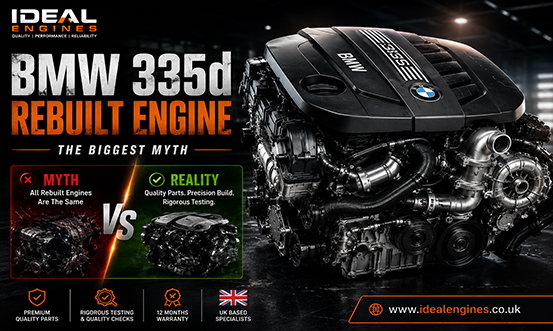
The Myth That Makes Sellers Rich and Buyers Poor: Rebuilt BMW 335d Engine Myths Blown Wide Open
This Advice is Costing Drivers Thousands: The Real Truth About Remanufactured vs New BMW 335d Engines (And Why Your Forum Post is Wrong)
If you’re reading this, you’ve probably spent the last 72 hours trapped in a browser tab nightmare. One forum says “never buy a used BMW engines – it’s a ticking time bomb.” The next says “remanufactured is a scam – they just jet-wash the block and call it rebuilt.” A YouTube comments section tells you to “just buy a cheap BMW engine for sale from a breaker and pray.”
Meanwhile, your car is sitting on axle stands, your wallet is haemorrhaging money on a hire car, and every day you delay costs you another £50 in rental fees.
I’ve been rebuilding BMW diesel engines for over two decades. I’ve seen the invoices. I’ve pulled apart the “reconditioned” units that were nothing more than a steam clean and a lick of paint. And I’ve watched drivers lose thousands because they believed a myth that some seller – often a competitor – had a vested interest in keeping alive.
The fact they don’t want you to know is this: the truth about rebuilt, reconditioned, and used BMW N57 engines is far more nuanced than any forum post will admit. And the difference between a good decision and a catastrophic one comes down to understanding exactly what you’re buying – not what the listing says.
Let’s name the myths, show the sources, and give you the truth.
Does ‘Reconditioned’ Actually Mean What You Think It Does When Applied to a BMW Engine for Sale?
Let’s cut straight through the marketing waffle. The word “reconditioned” has no legal definition in UK law. None. Zero. A seller can jet-wash a 150,000-mile engine, change the oil, slap a sticker on it, and list it as a “reconditioned BMW engine for sale” – and that is perfectly legal under UK Trading Standards.
MYTH: “Reconditioned means the engine has been fully rebuilt to factory specifications.”
WHY IT EXISTS: The word sounds impressive. It implies care, expertise, and a thorough process. Sellers know this. By using a term with no legal meaning, they can imply a level of quality without actually delivering it – and if you complain later, they can simply say “reconditioned means different things to different people.” It’s a linguistic loophole that has made many a used engine seller very comfortable indeed.
NUANCED REALITY
A genuinely reconditioned BMW N57D30 engine has been stripped, cleaned, inspected, and had some damaged components replaced before being rebuilt. But “some” is doing a lot of heavy lifting there. It may mean the piston rings were replaced. It may mean nothing more than the gaskets were changed. Crucially, reconditioning does not require parts to be returned to OEM specification – unlike remanufacturing, which is governed by the British Standard BS AU 257:2002.
As Ivor Searle – one of the UK’s most respected engine remanufacturers – makes clear: “A reconditioned engine is a unit that has been stripped or disassembled, cleaned and may have had some damaged components replaced prior to being rebuilt. It’s not always the case…”. That last clause is the killer. “Not always the case” means you have no idea what you’re actually getting.
WHAT THIS MEANS FOR YOU: When you see a “reconditioned BMW 335d engine for sale,” your first question must be: “What exactly was done to this engine? Provide a written list.” If the seller can’t or won’t give you a detailed breakdown of every component inspected, measured, and replaced – walk away. You are not buying a reconditioned engine; you are buying a mystery box with a shiny label.
What most independent garages won’t tell you is that many “reconditioned” engines supplied by national chains are actually just used engines that have been degreased, painted, and fitted with new gaskets. The profit margin on this is enormous – and the failure rate is significantly higher than properly remanufactured units. Always ask for the BS AU 257:2002 standard to be referenced in writing. If they can’t, you’re being sold a pig in a poke.
Is It True That Reconditioned BMW 335d Engines Simply Reuse Worn-Out Parts – What the Teardown Data Shows?
This is the myth that keeps drivers awake at night. And unlike the previous myth, this one has some truth to it – which makes it far more dangerous.
MYTH: “All reconditioned engines just reuse old, worn-out parts – they’re basically used engines with a clean.”
WHY IT EXISTS: Because some sellers do exactly that. And when a driver buys one of those engines and it fails, they go online and warn everyone that “reconditioned engines are a scam.” The myth persists because it’s true in some cases – but not all. The half-truth is what makes it so sticky.
NUANCED REALITY
A properly reconditioned BMW N57D30 engine involves a genuine strip-down, inspection, and replacement of components that fall outside manufacturer tolerances. The difference between a “good” reconditioned engine and a “bad” one is the standard to which it’s reconditioned.
Let’s look at the N57D30 specifically. This 3.0-litre twin-turbo diesel has known weak points: timing chain tensioners, piezo injectors, EGR coolers, and swirl flap motors. A genuine reconditioning should address all of these. A “jet-wash special” will address none of them.
The AA’s guidance on buying used engines emphasises the importance of verifying what has actually been replaced: “Prefer engines sourced from Authorised Treatment Facilities (ATFs) or reputable dismantlers”. But even ATFs don’t guarantee a full rebuild – they guarantee the engine was legally depolluted and dismantled. That’s a very different thing.
According to the RAC forum, “many replacement engines are not what they seem: They may have been properly remanufactured (stripped down and thoroughly checked) or they may be pulled out of a wreck and cleaned up”. The RAC’s warning is clear: the term on the listing tells you almost nothing.
WHAT THIS MEANS FOR YOU: A reconditioned engine is significantly more reliable than a standard used engine – if it has been properly reconditioned. But “properly” is the operative word. You need to verify:
- What was replaced? Timing chain? Injectors? Turbo? EGR cooler?
- What was measured? Bores? Crankshaft journals? Bearing clearances?
- What standard was used? Was it BS AU 257:2002 or “whatever the mechanic felt like”?
If the seller can’t answer these questions with specificity, you are buying a used engine with a fancy name.
What Forum Advice About BMW Engine for Sale Compatibility Is Actively Dangerous and Why?
Forums are a treasure trove of genuine owner experience. They are also a petri dish of confidently incorrect assertions that can cost you thousands.
MYTH: “Any N57 engine will fit any BMW that came with an N57 – they’re all the same.”
WHY IT EXISTS: Because it’s almost true. The N57 engine family includes multiple variants: N57D30O0 (E90/E91 335d), N57D30O1 (F30 330d), N57D30T0 (F10 530d), N57D30T1 (later models), and the N57S with triple turbos. They share the same basic architecture – but the differences in turbo configuration, ECU mapping, emissions equipment, and even the physical mounting points mean they are not interchangeable.
A forum user who successfully fitted a 330d engine into their 335d and got it running (after £2,000 of ECU work and custom fabrication) will confidently tell you “It’s a straight swap.” It isn’t. And if you follow that advice, you’ll be the one paying for the fabrication.
NUANCED REALITY
The rebuilt BMW N57D30B engine – the specific code for the 335d – uses a sequential twin-turbo setup with a swirl flap motor that is notoriously failure-prone. BMW actually issued Service Bulletin SIB 13 01 09 mandating swirl flap removal on affected vehicles. That’s a factory-authorized modification that must be carried out on any replacement engine.
Other variants have different turbo configurations, different DPF setups, and different EGR systems. Fit the wrong one, and you’ll have a car that won’t pass MOT emissions, won’t communicate with the ECU properly, and may not even physically fit in the engine bay.
Honest John, the UK’s most trusted car advice source, has documented numerous cases of N57 timing chain failures – but crucially, the advice always references the specific engine code and model year. That’s because the failure modes vary by variant. The 335d’s N57D30 has different timing chain tensioner behaviour than the 530d’s N57D30T0.
WHAT THIS MEANS FOR YOU: When searching for a “BMW engine for sale,” you must verify the exact engine code. Not “N57.” Not “3.0 diesel.” The full code: N57D30B (or N57D30O0 for earlier E90 models). Check the engine number on your existing unit, cross-reference it with the donor engine, and confirm compatibility with a specialist – not a forum post.
Explore More About BMW Engines
- BMW 335d, a Machine with Ultimate Power Along with Classy Interior
- Yet Another Driving Beauty BMW 3 Series
- BMW 3 Series is Dominating the Compact Executive Sector
- New Editions to BMW 3 Series
- The Terrific BMW 3 Series – F30
People Also Ask
What is the most common problem with the BMW N57 engine?
The most common problems with the BMW N57 engine are timing chain tensioner failure, fuel injector issues, and EGR valve clogging. The timing chain tensioner can fail due to oil pressure issues, leading to chain stretch and potentially catastrophic engine damage.
Is the BMW N57 engine reliable?
Yes, the BMW N57 engine is generally considered reliable when properly maintained. It has a reputation for longevity and low susceptibility to major defects, but it does have known weak points that require preventative maintenance. The key is regular oil changes and addressing warning signs promptly.
How long does a BMW N57 engine last?
A well-maintained BMW N57 engine can last 200,000 miles or more. However, this depends heavily on service history – engines with stretched oil change intervals are far more likely to suffer premature failure.
What is the difference between reconditioned and remanufactured engines?
A reconditioned engine is stripped, cleaned, and may have some damaged components replaced. A remanufactured engine is completely disassembled, every component is inspected and measured, and any part not meeting factory specifications is replaced – it’s rebuilt to the British Standard BS AU 257:2002. Remanufactured engines are the higher quality option.
Is a used BMW engine worth buying?
A used BMW engine can be worth buying if it comes from a reputable source with verified mileage and service history. However, it carries significant risk – you’re buying an unknown quantity. A reconditioned or remanufactured engine offers greater certainty and typically comes with a warranty.
What should I look for when buying a rebuilt BMW 335d engine?
Look for detailed documentation of what was replaced, evidence of testing, a comprehensive warranty (12 months minimum), and reference to the BS AU 257:2002 standard for remanufacturing. Verify the exact engine code – N57D30B – and ensure the seller can provide a written parts list.
Can I fit a different N57 engine into my BMW 335d?
Not all N57 engines are interchangeable. The 335d uses the N57D30B (or N57D30O0 for earlier models) with specific turbo configuration and ECU mapping. Fitting a different variant requires significant ECU work and may cause emissions and compatibility issues.
The Bottom Line
You’ve now read the myths, seen the sources, and understood the nuanced reality behind each one. You know that “reconditioned” has no legal meaning – but that a properly reconditioned engine is a solid option. You know that the N57’s reputation is unfairly tarnished by the N47’s failures. You know that a remanufactured engine is the gold standard – but it’s not a new engine.
And you know that the cheapest option is rarely the smartest.
The facts have done the selling. Now it’s over to you.
Ready to find a quality BMW 335d engine that won’t leave you stranded?
[Browse our verified inventory of reconditioned and remanufactured N57D30 engines – each with full documentation and a 12-month warranty.]
Categories
- 2013 Dubai Motor Show
- 2013 Frankfurt Motor Show
- 2013 Geneva Motor Show
- 2013 Shanghai Motor Show
- 2013 Tokyo Motor Show
- 2014 Detroit Auto Show
- 2014 Geneva Motor Show
- 2014 New York Motor Show
- 2014 North American International Auto Show
- Alfa Romeo
- Aston Martin
- Audi
- Audi A4 Check Engine Light
- Automotive News
- Avensis
- Beijing International Motor Show 2014
- BMW
- Cadillac
- Chevrolet
- Chicago Auto Show 2014
- Chrysler
- Citroen
- Daihatsu
- Detroit Motor Show 2013
- Diesel Engines
- Engines
- EV
- Fiat
- Ford
- General
- General Motors
- Geneva Motor Show 2014
- GM
- Guest Post
- Honda
- Hyundai
- Ideal Engines Reviews
- Infiniti
- Infographics
- Isuzu
- Jaguar
- KIA
- LA Motor Show 2013
- Lancia
- Land Rover
- LandRover
- Lexus
- Lotus
- Maserati
- Mazda
- McLaren
- Mercedes Benz
- Mini
- Mini Cooper S
- Mitsubishi
- New Technology
- Nissan
- Peugeot
- Porsche
- Range Rover
- Renault
- SEAT
- Skoda
- Smart
- Subaru
- Super Cars
- Suzuki
- Top Ten
- Toyota
- Transmissions and Gearboxes
- Uncategorized
- Vauxhall
- Volkswagen
- Volvo
- VW