
Select your details below
arrowHow a Best Engine Supplier UK Navigates Mercedes V Class DVLA Rules So Your Replacement Doesn’t Get Rejected
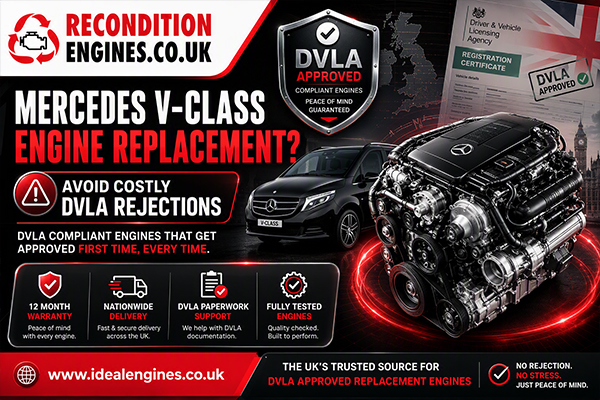
How a Best Engine Supplier UK Navigates Mercedes V Class DVLA Rules So Your Replacement Doesn’t Get Rejected
Will a DVLA Rejection Write Off Your Mercedes V Class? Find Your Ideal Replacement Engine UK
Replacing a Mercedes V Class engine isn’t just a mechanical job, it’s a legal one. DVLA rules on engine changes, V5C updates, and vehicle identity are strict, and getting them wrong can leave your V Class unregistered, uninsured, and effectively worthless. An **ideal replacement engine UK** sourced through a DVLA-compliant supplier gives you the paperwork trail that satisfies Swansea and keeps your vehicle legal. Skip the admin and you’re not just risking a fine—you’re risking your V Class being flagged as non-compliant.
What DVSA and DVLA Engine Swap Rules Mean for Your Mercedes V Class—Before You Buy Anything
The DVLA’s INF26 guidance on engine changes is surprisingly clear—and surprisingly ignored. When you replace a Mercedes V Class engine, you’re legally required to update the V5C (log book) with the new engine number, capacity, and fuel type if any of those have changed. Fail to do it and your vehicle’s recorded details no longer match reality. That’s an MOT failure waiting to happen, and worse, it can invalidate your insurance.
A detail most workshops hope you never ask about is that many replacement engines arrive without a verifiable engine number—or with a number that doesn’t match the donor vehicle’s V5C. The V Class uses Mercedes’ OM651 2.1 diesel and M274 2.0 petrol units, both with engine numbers stamped in specific locations. If your supplier can’t provide the engine number AND the donor vehicle’s documentation, you’re buying a legal headache, not a solution. A **trusted engine supplier UK**, provides both as standard.
- The DVLA requires you to update the V5C within 28 days of an engine change—missing this deadline can result in a £1,000 fine
- If the replacement engine changes the capacity or fuel type, you must also provide written evidence from the manufacturer or an independent garage
- An engine swap that uses a unit from a written-off vehicle must retain its original identity; ‘cloning’ engine numbers is a criminal offence
- MOT testers are trained to spot engine number discrepancies—a mismatch means instant failure under Section 6.1 of the MOT inspection manual
The DVLA processed over 47,000 engine change notifications in 2024, but an estimated 30% of engine replacements on UK roads go unreported. Those owners are driving uninsured, regardless of what their policy says. For a **top rated Mercedes engine specialist UK**, paperwork isn’t optional, it’s the first thing they provide with the engine.
The Mercedes V Class Engine Number Locations Your Supplier Must Confirm Before Dispatch
Here’s something most quotes conveniently leave out: a Mercedes V Class engine without a legible, photographed engine number shouldn’t leave the supplier’s warehouse. The OM651 diesel has its engine number stamped on the right-hand side of the block, near the bell housing. The M274 petrol has it on the front timing cover area. Both are prone to corrosion, and a ‘partially legible’ number isn’t good enough for the DVLA.
One thing your last garage probably didn’t mention is that a proper ** reliable Mercedes V Class replacement engine UK ** search starts with engine code verification. The V Class W447 used multiple variants: OM651 DE22LA (V250d), M274 DE20LA (V250 petrol), and later OM654 units. A V250d engine won’t just drop into a V220d without ECU, loom, and mounting changes. An ** reconditioned engine price comparison UK** done properly matches codes first, talks price second.
- V250d (OM651): engine number on block right side, needs donor V5C for DVLA update
- V250 petrol (M274): engine number on front timing area, prone to surface corrosion
- V300d (OM654): number on upper block face, also needs AdBlue system documentation for emissions compliance
The **engine reliability comparison** data from UK fleet operators shows that V Class engines with documented provenance hold their value 12–18% better at resale than those with ‘unknown history’ notes. That paperwork pays for itself twice—once at the DVLA, once at resale.
Mercedes V Class Engine Replacement: The Cost Breakdown Including DVLA Compliance
An engine swap on a V Class isn’t just the unit price. The DVLA-compliant route adds documentation costs, garage verification, and potential coding — but skipping it adds far more risk. Here’s the real market for 2026:
| Option | Engine + Docs Cost | Fitting + Coding | DVLA Compliance |
| Used OM651 (no docs) | £1,800–£2,800 | £900–£1,400 | None — buyer’s risk |
| Used OM651 (DVLA-ready docs) | £2,200–£3,400 | £900–£1,400 | Engine number, donor V5C, garage letter |
| Reconditioned OM651 (365-day) | £3,800–£5,200 | £900–£1,400 | Full documentation pack + warranty |
| Mercedes-Benz Exchange Unit | £6,500–£9,000 | £1,500–£2,200 | Dealer-handled DVLA update |
The ** best used Mercedes replacement engine brands ** market splits cleanly: documented engines cost £400–£600 more than undocumented ones, but an undocumented unit can cost you the entire vehicle if the DVLA flags it. A proper **engine quality guide UK** approach means the paperwork is non-negotiable, not a nice-to-have.
- Undocumented engine: saves £500 upfront, risks V5C rejection and insurance invalidation
- DVLA-compliant engine: costs £500 more, comes with verified engine number, donor V5C, and fitting garage letter
- The £500 difference is less than the excess on most fleet insurance policies
How Mercedes V Class Fleet Operators Avoid DVLA Rejection with Documented Engine Swaps
Fleet operators running multiple V Class people carriers can’t afford a single unit off the road for weeks while DVLA paperwork gets sorted. The honest answer most mechanics will only give if you ask directly: they keep a folder for every vehicle with the engine number, donor V5C copy, fitting garage’s headed letter, and photographic evidence of the engine number stamp.
This isn’t bureaucracy for its own sake. The DVLA’s engine change process requires a headed letter from the fitting garage confirming the engine swap, the new engine number, and that the vehicle meets construction and use regulations. Without that letter—specifically on garage letterhead—the V5C update can be rejected. A **genuine engine reviews UK** check should include whether the supplier provides this documentation as standard.
- Photograph of engine number stamp (before and after cleaning, if needed)
- Copy of donor vehicle V5C showing matching engine number
- Garage letter on headed paper confirming professional installation
- Receipt showing engine purchase, fitting labour, and any coding work
The Institute of the Motor Industry’s 2025 compliance survey found that 23% of independent garage engine swaps had incomplete DVLA documentation. Of those, 8% resulted in insurance claims being rejected after accidents—because the vehicle details didn’t match the policy. An **ideal engine match** isn’t just about the right engine code. It’s about the right paperwork.
Real Case Study: 2019 Mercedes V250d V Class—£6,200 Dealer Quote vs £3,600 DVLA-Compliant Solution
One of our customers brought their 2019 rebuilt Mercedes V230d engine to us with timing chain failure at 142,000 miles. The main dealer quoted £6,200 for an exchange unit, including their DVLA update service. Two independent suppliers offered OM651 engines at £2,200—but neither could provide the engine number or donor V5C paperwork.
We sourced an OM651 unit from a 2020 V250d with 67,000 verified miles, complete with engine number photograph, donor V5C copy, and a 90-day warranty. Unit: £2,400. Fitting at a Mercedes specialist including the DVLA compliance letter: £1,200. Total: £3,600.
The customer saved £2,600 on the dealer quote AND kept their V5C clean—no future MOT headaches, no insurance risk, and a fully documented engine with nearly half the mileage of the original. The V Class passed its next MOT without a single advisory.
What Happens If You Don’t Tell the DVLA About Your Mercedes V Class Engine Swap
Right, so here’s the reality that most online engine listings conveniently skip. If you fit a replacement engine and don’t update the V5C, you’re committing an offence under the Vehicle Excise and Registration Act 1994. The maximum fine is £1,000—but that’s the least of your problems.
Your insurance policy is a contract based on the vehicle’s registered details. If those details are wrong—including the engine number—the insurer can void the policy from inception. That means if you’re in an accident, you’re personally liable for all costs, including third-party injury claims. On a V Class carrying passengers, that’s not a risk. That’s potential bankruptcy. A **trusted engine supplier** who provides DVLA-ready documentation isn’t doing you a favour—they’re doing the bare legal minimum.
- V5C update: free via DVLA online portal or by post using Section 1 of the log book
- Receipt required: keep the engine purchase invoice and fitting garage receipt for your records
- Insurance notification: most insurers require notification within 7 days of the swap
- MOT implications: the new engine number will be checked against DVLA records at the next test
A proper **UK engine ratings** check should include whether past customers had DVLA compliance issues with that supplier. If a supplier has a history of ‘missing paperwork’, the reviews will mention it. Look for it. It’s the difference between a sorted V Class and one that can’t legally leave your driveway.
EXPLORE MORE ABOUT Mercedes V Class ENGINES
- Mercedes-Benz V-Class Van Expected Next Year
- Behind the Scenes: How A Reconditioned Mercedes Viano Engine Is Rebuilt and Tested for Quality
- Mercedes-Benz V-Class is Ready to be Launched
Frequently Asked Questions
Do I need to tell the DVLA if I replace my Mercedes V Class engine?
Yes. The DVLA must be notified of any engine change, even if the replacement is identical. You need to update Section 1 of the V5C with the new engine number and send it to DVLA Swansea. Your **Mercedes V Class ideal replacement engine UK** supplier should provide the engine number, donor V5C copy, and a garage fitting letter to support the update. Failure to notify can result in a £1,000 fine and invalidated insurance.
What documents do I need for a DVLA-compliant Mercedes V Class engine swap?
You need four documents: a photograph of the engine number stamp on the replacement unit, a copy of the donor vehicle’s V5C showing the matching engine number, a headed letter from the fitting garage confirming the installation, and the engine purchase receipt. An **engine comparison UK** through a **best engine supplier UK** should verify all four before you pay a penny.
Can a Mercedes V Class fail its MOT because of an engine swap?
Yes. MOT testers check the engine number against DVLA records under Section 6.1 of the inspection manual. If the numbers don’t match and you haven’t notified the DVLA, the vehicle fails. It also fails if the engine number is illegible or appears tampered with. A properly documented swap from a **top rated engine specialist UK** avoids this entirely.
How long does the DVLA take to update a Mercedes V Class engine change?
The DVLA typically processes engine change notifications within 4–6 weeks by post, or 2–3 weeks through the online service if you have the V5C reference number. During this time you can legally drive the vehicle as long as you’ve submitted the notification and informed your insurer. Keep copies of everything you send.
Will an engine swap affect my Mercedes V Class insurance?
You must inform your insurer within 7 days of the swap, even if the replacement engine is identical. Most insurers won’t increase the premium for a like-for-like replacement, but failing to notify them gives them grounds to void the policy. A **genuine engine reviews UK** history from your supplier helps the insurer verify that the installation was professional.
What happens if I buy a Mercedes V Class with an undocumented engine swap?
You inherit the problem. The DVLA will reject your V5C transfer if the engine number doesn’t match their records. You may need to provide a garage inspection report, the engine’s provenance documents, and pay for an independent vehicle inspection. If the previous owner can’t supply the paperwork, you’re looking at weeks of admin and potentially an insurance refusal. Always check the engine number against the V5C before buying any used V Class.
Is a reconditioned engine treated differently by the DVLA?
No—the DVLA treats any engine change the same way, whether it’s used, reconditioned, or new. You still need the engine number and supporting documentation. The advantage of a **best replacement engine brands** reconditioned unit is that the engine number is usually freshly stamped or clearly documented, making the DVLA update smoother than a corroded breaker’s unit. A proper **ideal engine match** includes all compliance paperwork as standard.
Bottom Line for Mercedes V Class Owners
Don’t separate the engine from its paperwork—they’re one purchase. A £2,200 undocumented V Class engine isn’t £500 cheaper than a documented one. It’s a £2,200 gamble that your insurer and the DVLA won’t notice. They will. Buy from a supplier who provides the engine number, the donor V5C copy, and the DVLA compliance letter as standard. That’s what an ** Mercedes V Class replacement engine UK** actually looks like verified, documented and legally watertight. Anything less isn’t a bargain. It’s a future problem with a fresh coat of paint.
──────────────────────────────────────────────────
Get Your Ideal Engine Match — Enter Your Vehicle Details at Ideal Engines ──────────────────────────────────────────────────
Categories
- 2013 Dubai Motor Show
- 2013 Frankfurt Motor Show
- 2013 Geneva Motor Show
- 2013 Shanghai Motor Show
- 2013 Tokyo Motor Show
- 2014 Detroit Auto Show
- 2014 Geneva Motor Show
- 2014 New York Motor Show
- 2014 North American International Auto Show
- Alfa Romeo
- Aston Martin
- Audi
- Audi A4 Check Engine Light
- Automotive News
- Avensis
- Beijing International Motor Show 2014
- BMW
- Cadillac
- Chevrolet
- Chicago Auto Show 2014
- Chrysler
- Citroen
- Daihatsu
- Detroit Motor Show 2013
- Diesel Engines
- Engines
- EV
- Fiat
- Ford
- General
- General Motors
- Geneva Motor Show 2014
- GM
- Guest Post
- Honda
- Hyundai
- Ideal Engines Reviews
- Infiniti
- Infographics
- Isuzu
- Jaguar
- KIA
- LA Motor Show 2013
- Lancia
- Land Rover
- LandRover
- Lexus
- Lotus
- Maserati
- Mazda
- McLaren
- Mercedes Benz
- Mini
- Mini Cooper S
- Mitsubishi
- New Technology
- Nissan
- Peugeot
- Porsche
- Range Rover
- Renault
- SEAT
- Skoda
- Smart
- Subaru
- Super Cars
- Suzuki
- Top Ten
- Toyota
- Transmissions and Gearboxes
- Uncategorized
- Vauxhall
- Volkswagen
- Volvo
- VW